Blog Archives
Latest HIV blood results (August 2013)
Last week I popped into the HIV clinic to have my bloods taken, nine vials of the damned stuff – bleeding vampyrs! Today I popped back to get my results.
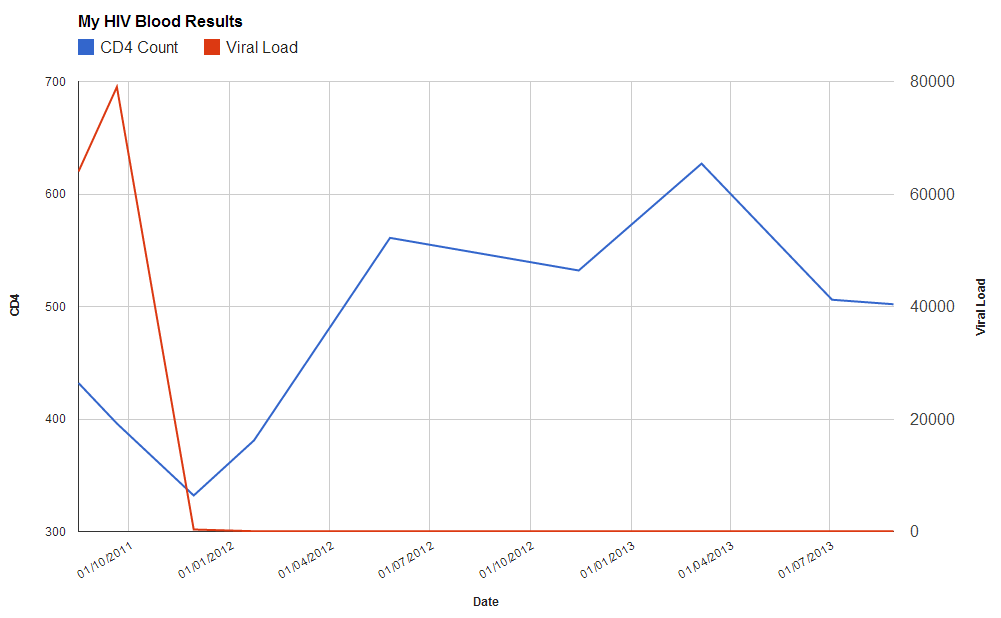
As you can see my CD4 has remained steady-ish, 502 at latest count and my Viral Load (VL) is staying at ‘undetectable’ with <39 copies per ml of blood. All of this is good news, it means my medication is working properly (always a worry when you change meds) and my immune system is holding up to the stress.
 The only thing they did mention is that my blood cells are slightly larger than normal, at 100.7% of their normal size (which doesn’t seem much) so they’ve prescribed me some Folic Acid supplements to try and bring that back down to 100%.
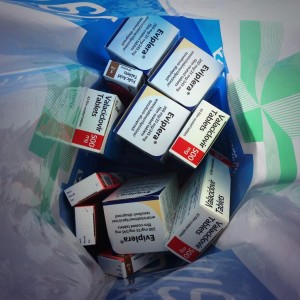
After that I popped to the pharmacy to fill my prescription for four months of meds. Most people get a small paper bag when they collect their prescription, when they see me coming they get out a huge plastic bag… I’m actually surprised that I don’t rattle!
Have a great day,
Tom
UKPositiveLad
Two years on, still strong. Thank you for your support.
 Sunday was a milestone for me, it was the two year anniversary of my HIV diagnosis.
Two years ago, on Thursday 4th August 2011, I was sat in Whittall Street Clinic Birmingham being told something that’d change my life forever – that I was HIV+.
The past two years have flown by, I’ve seen my CD4 as low as 364 and as high as 627, whilst my Viral Load has been on a constant drop from 79,000 to the ‘undetectable’ level it is now. I’ve gone from blogging anonymously about my fears of living with HIV to blogging publicly. I’ve written for a dozen magazines, as well as spoken on television and radio – heck I even launched the 2013 ICC Champions Trophy Cricket Final in front of 1.5bn people last month. When I started my blog over on WordPress just after my diagnosis I was too afraid to say who I was, I got a couple of hits a day and didn’t really know why I was doing it. Now in 2013 I’m out there, I’m getting 10,000 hits and 50-60 odd emails asking for support each day.
But whilst that’s exciting and everything, the biggest thing for me is how much I’ve come to terms with what is essentially a life long condition in such a short period of time and how I’ve been able to make use of my experience over the last couple of years to help other people who are coming to terms with their own diagnoses. Over the last year or so I’ve been volunteering at one of the local HIV clinics – offering a chaperon service to people new to the clinic, it’s been one of the most rewarding things I’ve ever done. I’ve even personally raised over £8,000 for various HIV charities – which wouldn’t be possible without your support.
At the end of this month, August, I’ll be taking part in a training course with THT to become an Online Peer Support Volunteer over at MyHIV.org.uk. It’s something I’ve wanted to do for a while but due to funding training course places are scarce – so I’m grabbing this opportunity with both hands!
To those who are just coming to terms with their own HIV diagnosis: Stand strong. Things may feel bad now, but just hold on in there. HIV is a bastard it’s true, but it doesn’t define who you are. You are and still can be amazing.
To those who have supported me along the way: Thank you, your constant love and support – it has been a constant source of strength for me, even in my darkest hours.
Thanks and all my love,
Tom
UKPositiveLad
New Meds & Blood Results – July 2013
Why hello there,
As you may have seen on Twitter I was at the HIV clinic on Wednesday morning – collecting my results from my quarterly blood tests.
The tests monitor a number of things, my Viral Load (VL), CD4 count, CD4 percentage as well as kidney function, liver function, cholesterol, vitamin and mineral levels. The most important of these being my VL & CD4.
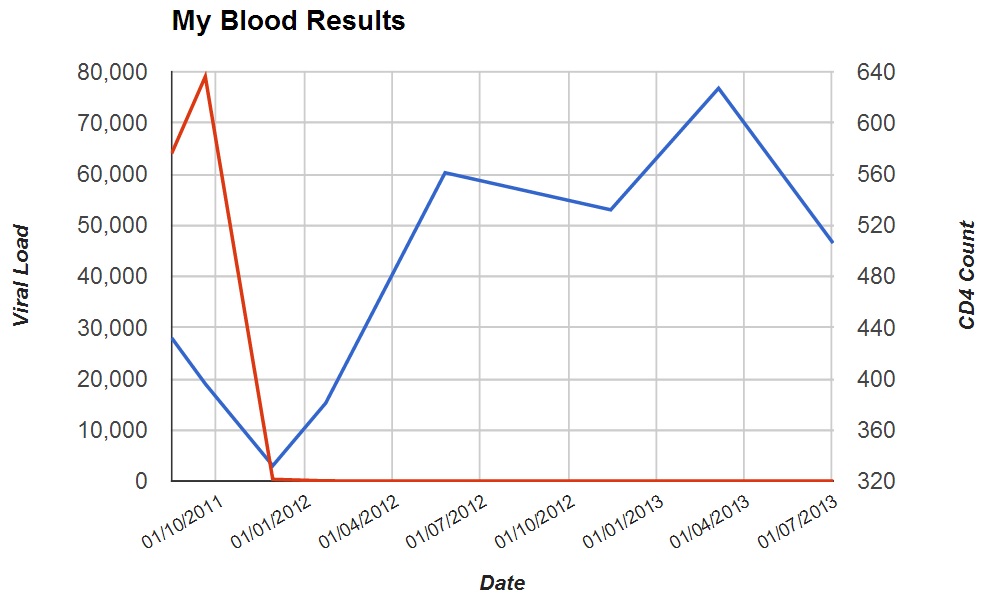
My VL has remained ‘undetectable’, and my CD4 has dipped a bit from 627 to 506 – but my consultant explained that whilst the count itself had dropped the percentage had actually gone up, this can be due to variation in sample sizes, the main thing to take away though is that my CD4 percentage is still rising, to 38% in fact, which is excellent. If you need further explanation of VL & CD4 head to this excellent interactive resource from aidsmap.com. I’ll make sure to get a record of my previous CD4 percentages next time I see the doctor to include in my graphs. Talking of which – HAVE A GRAPH…
I also started my new medication two weeks ago now. If you recall, I was experiencing horrible side effects on the ATRIPLA – which I talked about in my post ‘Am I mad, or is it the meds?’. My consultants changed me from ATRIPLA onto a newer medication, still in one pill format, called Eviplera. The pill is taking a little effort to integrate into my routine than I thought, previously I just popped my ATRIPLA when I climbed into bed at 11pm – but Eviplera is different, it has to be consumed with food (350kcal or higher). I’m finding myself having finished an evening meal and then suddenly thinking “Crap, I should have taken my pill with that meal!”, but I’m getting better at it.
The initial week was pretty hellish. As the ATRIPLA lingered in my system and the Eviplera started to take hold the two drugs (well six drugs, three per tablet) were clearly having some sort of battle royale in my organs. I felt dizzy, I was throwing up, I had headaches, I couldn’t eat – I could barely get out of bed. But now that I’ve adjusted I’m feeling so much better than I ever felt on ATRIPLA, I’m sleeping better, no more crazy dreams, no more hallucinations and I feel generally clearer in myself – almost like I’d been living in a fog before. Let’s hope that holds true in six months time.
Whilst I was at the clinic they mentioned that my red blood cells were larger than normal, but not by much. They’ve taken more blood to check for deficiencies in B12 and Folic Acid as a starting point. So I’m interested to see what comes back from those. It seems that in this case size really does matter.
Speak to you all soon,
Tom
UKPositiveLad
Just Get Tested Already

Morning all,
On a daily basis I get maybe thirty or forty emails from people reading this column or people visiting my website. Some are asking for support, others asking questions about HIV, a few are even hate-mail (the crazies are everywhere) – and an alarming number telling me that they’ve never had a HIV and/or STI (Sexually Transmitted Infection) screening.
Of course I always handle these messages sensitively. I suggest that they should go and book themselves in for a full STI screening and even provide a link to the Terrence Higgins Trust website where they can pop in their
postcode and find a clinic near them. But the whole exchange often leaves me baffled and concerned. Many of these people are in their mid-to-late twenties – how they have got this far in life (presumably having sex along the way) and never having had a check up?
Is it simply a case of sticking their heads in the sand or is there something more going on here? Having spoken to some of them in more depth there’s definitely some ostrich like behaviour for sure, for some ignorance really is bliss, if you don’t know something is wrong then you don’t need to worry about it – but for others it’s a fear of the testing process itself, and this can only be due to lack of education around the topic.
Going for a STI screening really is not that big a deal. Honestly. I went for one only the other month (I go every six months – and so should you if you’re sexually active). Here’s what happened:
I arrived at the clinic at about 10am. I sat around watching Jeremy Kyle in the waiting room until I was called through by a doctor. They ask you a few simple questions:
Why’ve you come in today? “routine testing”,
Do you have any symptoms? “none”,
Any pre-existing conditions? “HIV-positive”.
After that I head back to the waiting room for a couple of minutes for a spot more Jezza (turns out he wasn’t the father). Then a nurse calls me through to one of the other rooms. She takes a couple of throat swabs (say “ahhhh”), a tiny swab from the end of my penis (it does pinch a little, but it doesn’t hurt), and a swab from my ass. Another nurse comes into to take a couple of vials of blood and then I’m given a little bottle to go put a urine sample in. I’m good to go. That’s it! takes about 45 minutes, one hour tops. They’ll text me any results in two weeks time.
(If I didn’t already know that I was HIV-Positive they would have also offered a HIV Rapid Test, which gives you a result in 15 minutes)
It’s incredibly important that each of us get regular STI screenings. Most sexual health charities recommend twice a year or more frequent if you’re more sexually active. Whilst you may not have any symptoms you may still carry any number of infections without even knowing it. I myself had absolutely none of the ‘flu-like’ symptoms often associated with HIV and only found out at one of my regular screenings.
Getting checked out doesn’t just mean that you’re looking after yourself, it means you’re showing respect and looking out for those who you sleep with – after all you’d hope anyone you slept with to have been checked recently, wouldn’t you?
So if you’ve never been checked out, or maybe it’s been far too long since your last test perhaps today’s good deed could be calling up your clinic and booking yourself in for a little MOT. Don’t know where your nearest one is – sorry, that’s no excuse. Head over to THT.org.uk and click ‘Sexual health’ to use their ‘Service Finder’ tool.
Take care,
Tom
UKPositiveLad
Latest Blood Results – March 2013
G’day Lads and Lasses,
Yesterday I went to my local HIV Clinic at the lovely Queen Elizabeth Hospital Birmingham. I popped in to get the results from my routine blood-work I had done last week.
My consultant gave me my latest figures: My CD4 is up from 534 to 627 (yay) and my Viral Load remains undetectable (double yay).

Now for those of you who aren’t au fait with the terminology here are some a couple of quick explanations from aidsmap.com:
- T-cells (or T-lymphocytes) are white blood cells that play important roles in the immune system. There are two main types of T-cells. One type has molecules called CD4 on its surface; these ‘helper’ cells organise the immune system’s response to bacteria, fungi and viruses. The other T-cells, which have a molecule called CD8, destroy cells that are infected and produce antiviral substances.HIV is able to attach itself to the CD4 molecule, allowing the virus to enter and infect these cells. Even while a person with HIV feels well and has no symptoms, billions of CD4 cells are infected by HIV and are destroyed each day, and billions more CD4 cells are produced to replace them. Doctors use a test that ‘counts’ the number of CD4 cells in a cubic millimetre of blood. A normal CD4 count in a healthy, HIV-negative adult can vary but is usually between 600 and 1200 CD4 cells/mm3 (though it may be lower in some people).
- Viral load is the term used to describe the amount of HIV in your blood. The more HIV there is in your blood (and therefore the higher your viral load), then the faster your CD4 cell count will fall, and the greater your risk of becoming ill because of HIV. Viral load tests measure the amount of HIV’s genetic material in a blood sample. The results of a viral load test are described as the number of copies of HIV RNA in a millilitre of blood. But your doctor will normally just talk about your viral load as a number. For example, a viral load of 10,000 would be considered low; 100,000 would be considered high.
- All viral load tests have a cut-off point below which they cannot reliably detect HIV. This is called the limit of detection. Tests used most commonly in the UK have a lower limit of detection of either 40 or 50 copies/ml, but there are some very sensitive tests that can measure below 20 copies/ml. If your viral load is below 50, it is usually said to be undetectable. The aim of HIV treatment is to reach an undetectable viral load.But just because the level of HIV is too low to be measured doesn’t mean that HIV has disappeared completely from your body. It might still be present in the blood, but in amounts too low to be measured. Viral load tests only measure levels of HIV in the blood, which may be different to the viral load in other parts of your body, for example in your genital fluids, gut or lymph nodes.
The dietician is slightly concerned about my weight however, I used to weigh between 62 and 64kg (that’s 9st 10lb – 10st in old money) and now I weigh 56Kg (8st 11lb). So they’ve put me on a new diet – where essentially they want me to be eating all day long. Lots of things rich in sugar, fat, dairy and protein. Not sure how I’m going to afford that mind!
To combat the rising number of cold-sores I’ve been getting too my consultant has put me on a daily dose of Valaciclovir to combat those at the root cause, hopefully we can get that under control too. All in all a pretty productive trip to the hospital, all done for four months now!
Until tomorrow lovely people,
Tom
UKPositiveLad
Doctor Christian talks condoms…
Well hello there,
This week I’m lucky enough to have a guest post from our favourite TV doctor and fellow Attitude columnist, the handsome Doctor Christian Jessen. In this post we won’t be discussing embarrassing bodies or healthy eating, but rather condoms – the simple tool for safer sex…

We all know that condoms offer us the best protection (98% effective when used properly) from both STIs (Sexually Transmitted Infections) and unwanted pregnancy, but are you sure that you’re using them correctly?
Don’t be so sure: a study of 1,400 teens by Southampton University found that 6% had put the condom on too late and another 6% took the condom off too soon.
Here are some simple DOs and DON’Ts to make sure you’re using your condoms properly:
DOs
 Only use approved latex or polyurethane condoms that bear the BS Kite mark.
- Make sure you have the right condom for YOU – just like penises they come in many sizes.
They can be measured for at home by you and ordered online to save any embarrassment. - Check the date before you use it, out of date condoms become brittle and break.
 Make sure you have the condom the right way round BEFORE you apply it to the head of your penis.
- With one thumb and finger grip the tip of the condom to squeeze out any air, then use your other hand to roll the condom as far down as you can.
- Use a water or silicon based lube – this reduces friction and reduces risk of breaking the condom.
- If you’re having a long session consider taking a break and switching to a new condom.
- If you’re playing with more than one partner (lucky you) – use a different condom for each person. The same applies to sex toys, put on condom on them and change with every partner.
- Pull out whilst you’re still hard – making sure to hold the base of the condom.
- Throw it in the bin, don’t flush it.
DON’Ts
- Don’t use an out of date condom – they can break more easily, and we don’t want that.
- Don’t bite condom wrappers open – you may damage the condom inside.
Remember that long nails can also cause damage to condoms. - Don’t unroll the condom until you’re ready to roll it down and over your penis.
- Don’t use an oil based lube (this includes Vaseline and baby oil) – the oil weakens the condom and can lead to it failing.
- Don’t re-use a condom, this shouldn’t need saying but we’ll throw it in anyway.
- Don’t use two condoms at once – the friction between them can tear both condoms.
- Don’t use a condom and a female condom (or femidom) together for the same reason.
You can buy condoms at supermarkets, pharmacies and most convenience stores, if you’re too shy to do it in person why not order yourself some online from NHS Freedoms, and don’t forget that you can always pick some up for free from your local Sexual Health Clinic.
Good Health,

Doctor Christian Jessen
Your HIV questions answered by DrEd.
Currently 100,000 people are estimated to be living with HIV in the UK, but an estimated 25% of those are undiagnosed.
That’s 25,000 people who have HIV and don’t know about it! As we come to the end of HIV Testing Week in the UK and approach World AIDS Day 2012 I put some of your questions about getting tested and HIV to Dr Sebastian Winckler from DrEd.
1. Why is it so important to get tested for HIV?
Early testing is vital both for you, and for the people you’re sleeping with.
If you’ve got HIV and you’re getting treatment you can expect to live 40 years longer than someone who isn’t receiving treatment.
If you’re taking antiretroviral medication, you become less infectious to other people. Being aware of your status means you can start putting certain measure in place (such as safe sex)
to prevent transmission, as well as looking after your own health.
2. What stops some people from getting tested?
There are a lots of reasons why people avoid HIV tests, but usually it’s down to:
- The stigma surrounding HIV and AIDs: Despite advancements in treatment, in some communities there is still stigma about being HIV+, so many people feel embarrassed about getting tested. Remember, there is no shame in being HIV+.
- The inconvenience of testing: If you work during the day, it can be hard work finding the time to go.
- Fear: Some people are simply scared off getting a result they don’t want to hear. Remember though, it’s better to get tested and treated rather than making yourself, or others, ill.
3. Where can I get tested?
HIV tests are available free and confidentially from:
- Sexual health (GUM) clinics
- HIV testing centres (Terrence Higgins Trust Fastest centres, for example)
- LGBT Centres
- GP’s and family doctors
- HIV tests are available to buy from:
- Private clinics
- Online doctors services
4. I haven’t had any symptoms, so I probably don’t have HIV, right?
Wrong. Most people will experience a short, flu-like illness about 2- 6 weeks after being infected. This is your immune system putting up an initial fight against the virus and can last for up to a month. But, this can be easily mistaken for the flu and 20% of people don’t experience any symptoms at all.
After this has gone away, you are unlikely to notice any other symptoms for a long period of time. So the only way of knowing for sure is getting yourself tested.
5. Can a test pick up any HIV infection, regardless of when I’ve caught it?
No. A certain amount of genetic material needs to build up in your system before it can be accurately detected by a test. The time taken for this to happen is called the ‘window period’ and this is different for every test.
- The standard antibody (Ab) test will pick up HIV if you caught it more than 3 months ago.
- The combined antibody/ antigen test (4th Generation test) will pick up HIV if you caught it more than 6 weeks ago.
- The HIV PCR test will pick up HIV if you caught it more than 7-10 days ago.
In most cases, you will be given either the standard antibody or combined test. If you test negative for these, it doesn’t necessarily mean that you are HIV negative, because you might have been infected within the last 3 months (or 6 weeks). You are therefore advised to take a second test 3 months later for the all clear.
If you want a faster result you can pay for a PCR test. But these are only offered at some clinics and may cost up to £250.
6. I think I’ve caught HIV within the last few days, what do I do?
If you’re worried that you’ve contracted HIV very recently, as in, within the past 72 hours (3 days) then you should go to your local GUM clinic or A&E department and request emergency PEP treatment.
7. I’m afraid to get tested because I don’t like needles
HIV tests don’t have to be done via needle or syringe, some clinics use ‘Fastest’ Rapid Testing which simply takes a prick on the end of your finger. Other clinics may take oral swabs instead, this method is considered less effective than a blood test however, so some clinics won’t offer it.
8. How long do I have to wait for my results?
That depends on the clinic you go to. Most will contact you with your result (or ask you to come back in for it) within 3-5 days. If you take a rapid test your result will be ready within the hour. Some clinics can take up to 2 weeks however, don’t be afraid to ask when you should expect the results.
9. What happens if I test positive?
First off, a positive result doesn’t always mean you’re HIV+. There is a small margin of error, so all positive results must be followed up by a confirmation test.
If you do test positive for that, then the doctor or nurse who informs you of your result will set up a meeting with a specialist who can assess the stage of your infection and talk to you about relevant treatment options. You’ll be put in touch with local HIV support groups who can help you cope emotionally, and make you realise that a positive result is not the end.
Thirty years on and HIV is still a problem in the UK, but it is no longer a death sentence. There is help out there and the earlier you get tested, the better your prospects. Whatever you do, make sure you get tested this HIV Testing Week.
Some charities that can help:

My Latest Results
Happy Moist Wednesday to you all,
Yesterday I went to collect the results from my triannual (is that a word? three times a year anyway) HIV check up at the clinic. I’d been in the week before and had the full battery of tests – 8 vials of blood and a urine sample, along with a full standard STI (sexually transmitted infection) screening. It takes one week from the tests to get all the results, so in I popped after work.
It always surprises me how lovely the staff are, they always remember my name despite the hundreds, if not thousands, of people they see between my check-ups. My usual consultant wasn’t available, sunning himself in the tropics – alright for some, so I saw a different lady who had me laughing the entire time.
The long and short of it however is my Viral Load is holding at <39 (which means undetectable), and my CD4 was a respectable 532 (see chart below), my CD4 is a bit down from last time, but the doctor attributed that to my recent bout of flu. So that’s all good. The STI screening was clean as a whistle too – hardly surprising given my pretty quiet bedroom life of late.
I saw the dietician who told me that my cholesterol, kidney and liver functions were all fine – and quizzed me on how healthy my diet was. The physiotherapist moaned at me for not doing enough exercise, and the health advisor gave me a suitcase of condoms and lube.
On to the pharmacist we had a yearly medication review, we discussed my minor side-effects (occasional insomnia and crazy dreams) and decided that it was best to stick with the current medication regimen. I was offered a new home delivery service for my medication as it was suggested it would be more convenient for me, but then I’d have to wait in for the delivery (or else trek to the Post Office) and I have to come in every four months for my check-up anyway, so might as well collect them then.
I picked up my four month supply of ATRIPLA and headed home. At £626 per month (cost to the NHS) that meant I was carrying £2,504 of medication around. I felt like it should probably be handcuffed to me like in the movies! Thank goodness that it doesn’t cost me a penny on the NHS, not even a prescription charge. A lot of people complain about the NHS, and sure it does make mistakes but then what organisation doesn’t. We’re very lucky to have such an institution in our country – make the most of it whilst you can before the Tories dismantle it.
I hope you’re all well!
Sam
UKPositiveLad

HPV – what is it?
 A few days ago I had the pleasure to meet a lovely guy with whom I was lucky enough to spend the night. Before anything even started to happen he told me that he’d recently contracted HPV. I was incredibly impressed that a) he’d been so upfront/honest with me, and b) he’d managed to tell me before I’d told him my HIV status.
So we had a chat about our various issues, both starting and ending with H and ending in V but all in all quite different conditions. Although I thought I was quite clued up on Sexually Transmitted Infections (STIs) I really didn’t know all that much about HPV. He explained a little, as did I about HIV.
Yesterday, being the curious soul that I am, I decided to do a little research into HPV. I’ve heard it mentioned here and there, especially into vaccinating school girls but that’s about it. I did some googling, I spoke to a sexual health nurse and my HIV consultant and below are some of my findings.
- HPV (Human papillomavirus) is the virus responsible for warts.
- There are currently 120 known strains of the virus.
- HPV is the most commonly transmitted STI in the entire world, (second in the UK behind Chlamydia)
- Approximately 80% of the population will contract a genital strain of HPV in their lifetime, with the 20-24 year old age being the most prevalent, although most will not show symptoms.
- Condoms provide some protection, but not complete protection as they do not cover the entire genital area.
- The human body will clear most HPV infections within 2 years naturally.
- Worldwide 5.2% of all cancers can be traced back to the HPV virus (largely anal and cervical cancers)
I asked my consultant whether I should get vaccinated against HPV and he told me that I’d have to pay to have it done privately as I don’t fall under the current NHS vaccination remit – and that it’d likely be wasted money as he’d bet I’ve already been exposed to at least one strain in the past.
It’s amazing such a common virus, one that will reach approximately 80% of us at some point is so unknown isn’t it?
Just another reason to go get checked eh? For more information check out the NHS page on HPV
All the best,
Sam
UKPositiveLad
Lastest blood results – cause for celebration
Hey Hey,
Just a short blog-post as I did a big rambling one yesterday. I went to the clinic today, which I wasn’t really looking forward to. They took 8 vials of blood from me (as per usual), made me pee in a pot (not easy), weighed me (61.3kg) and checked my blood pressure (122/71) and then gave me four vaccinations:
- Hep B (booster)
- Pneumonia
- Meningitis
- Tetanus/Polio/Diphtheria
After that was out of the way I sat down with my consultant and she took me through my results from last time. I’ve made some real progress (as you can see in the chart below), my Viral Load is now 39 (technically “undetectable”), and my CD4 has risen to 561 (the highest it’s ever been).
In just one year my Viral Load has dropped from 79,000 to 39, and my CD4 has risen from a low of 332 to a high of 561. Proof if proof were needed that Highly Active Antiretroviral Therapy (HAART) really does work.
After that was done I headed to the pharmacist and picked up a four month supply of ATRIPLA and made my way home.
Just that little bit of good news has really perked me up. I’m seeing my best mate on Thursday too for drinks, something to look forward to there as well.

Hope you all have a good evening,
Sam
UKPositiveLad